Five shoes for a ten hour barista shift on a hard floor

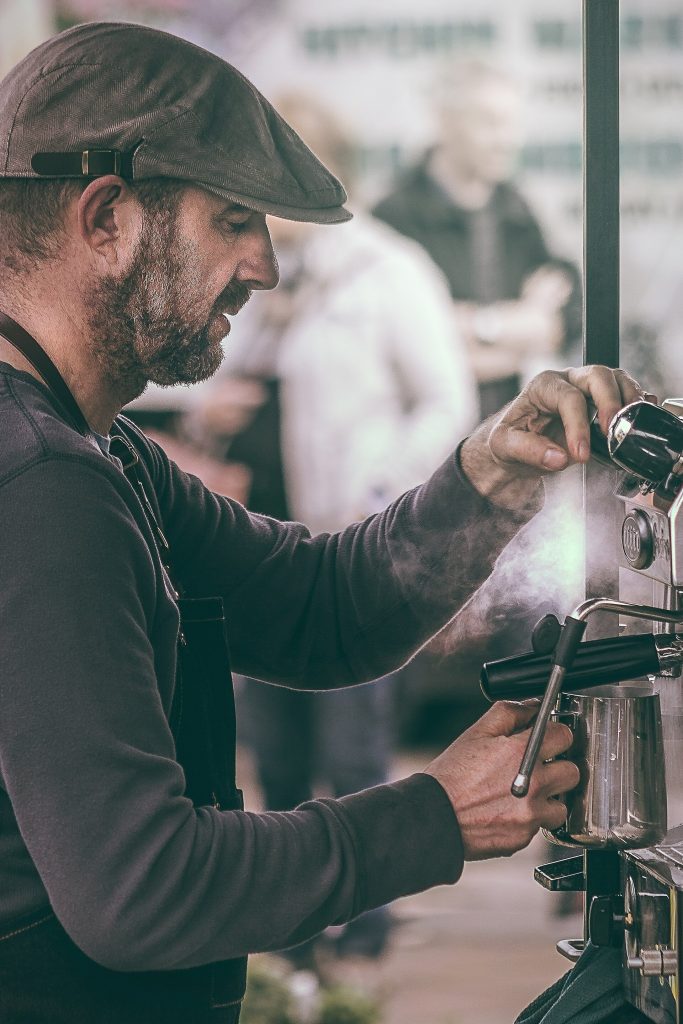
Behind a bar you do not walk, you pivot, and the floor is sealed concrete that has been wet since six. A shoe with grip and no pivot is a knee waiting to happen.
The motion is a three foot radius: reach to the grinder, turn to the steam wand, step to the till, crouch to the low fridge, and back again. Ten hours of that loads the ball of the foot and the inside edge of the ankle.
I worked a month of opens in each pair, on concrete with a rubber mat at the bar and bare concrete everywhere else. These five are the ones that were still usable at the end.
A pivot point under the ball, not a full lug
Every turn happens on the ball of one foot, and a lug pattern that grips in every direction fights that turn. The ankle and the knee absorb the difference, quietly, for months.
Look for a circular or oval smooth zone under the ball, with tread around it rather than across it. That is a deliberate pivot point, and it is not decoration.
Turn on a wet tile in the shop. A shoe that stutters and then releases at the ball is right; one that grips hard all the way round will twist your knee by month two.
The pivot also needs clearance around it. If the smooth zone runs right to the edge of the sole, the edge catches on the mat and the turn becomes a stumble instead of a rotation.
Rubber that holds on spilled milk, not just water
Milk and syrup are worse than water because they are sticky and they dry into a film. Water you can feel underfoot; a thin film of milk is invisible and just as slick.
A soft nitrile or high natural rubber compound with a fine texture holds on both. Hard, shiny rubber compounds skate as soon as there is any film at all.
Test it by spilling a little milk on a tile and stepping on it. If the shoe slides without a stutter, it will do that at the bar during the morning rush.
Syrup is the harder test, because it stays tacky and picks up grit. A sole that holds on milk can still skate on a dried spill of syrup, so wipe the floor and the sole at the same time.
A low profile that clears the mat edge
The rubber mat at the bar has a bevelled edge, and a thick, chunky sole catches it. Catching a mat edge with a full tray is how a shift ends early with a mop in your hand.
A sole of 20 to 25 mm at the heel, with a modest toe spring, clears the bevel without lifting the foot early in the step. Very thick platforms catch on everything.
Walk across the mat edge at an angle, because that is how you will actually cross it. If the toe stubs, the sole is too thick or too square at the front.
An upper that can take a milk jug to the shin
Milk, syrup and cleaning spray all land on the upper, and a porous material holds the smell. Canvas and suede are the two worst choices behind a bar for that reason.
A coated leather or a rubberised textile wipes clean in one pass. Check the seam at the toe, because that is where liquid pools and the thread takes the stain.
A darker colour hides the splashes that a pale shoe shows by lunchtime on day one. If you want a light upper, accept that it is a three month shoe.
A footbed for a static load with a moving pivot
Ten hours is mostly standing, with a turn every twenty seconds. The footbed has to hold thickness under the heel and stay put under the ball while it rotates.
A removable, closed cell footbed with a slight metatarsal bump spreads the load at the pivot point. A flat, soft liner compresses into a dish and stays there.
Pull it out after a week. A permanent dent under the ball means the foam is too soft, and the shoe will feel like a wet sponge by the end of the month.
Keep a spare liner in the back and swap it at the halfway point of a double. It is the cheapest way to make hour nine feel like hour two.
Bar work rewards a flat, grippy sole with one deliberate pivot and nothing else clever. Anything with a big lug is built for a walk you do not take.
Buy for the wet film and the turn. The ten hours look after themselves if the first twenty seconds of every order feel stable underfoot.