Five full grain leather shoes whose uppers look better after a year

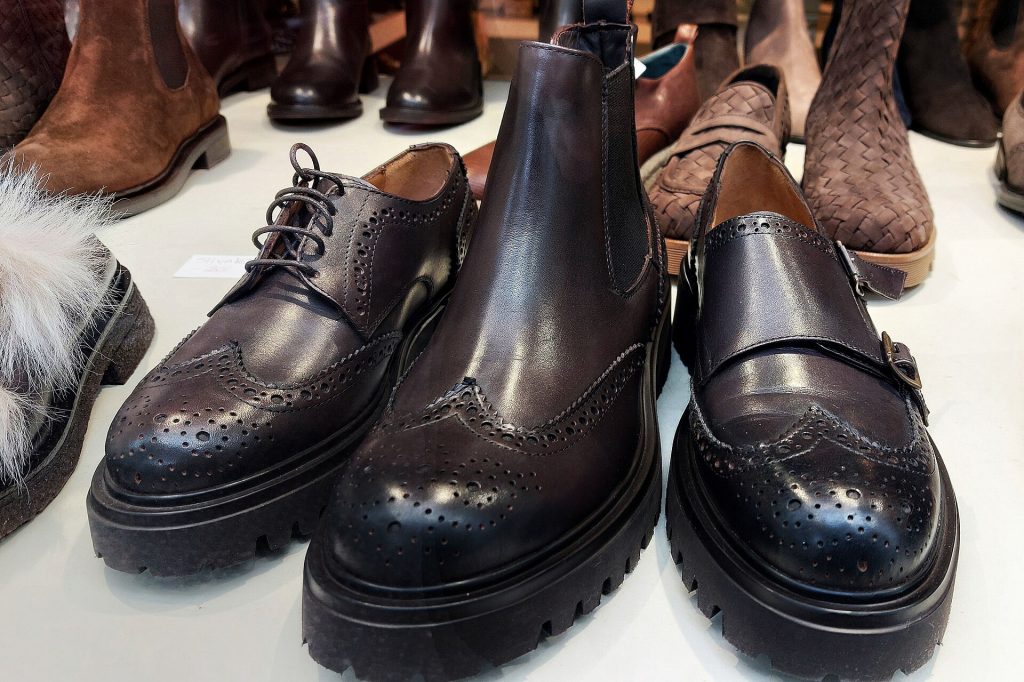
Full grain leather improves with age because its creases are compression, not fracture. The grain layer is still attached to the whole thickness of the hide, so it folds over itself rather than splitting away from a backing.
Every flex pushes oil along the fibre network inside the sheet. That slow migration is what darkens the crease line first and gives the upper its uneven sheen a year in.
What separates a pair that patinas from a pair that only looks dirty is how much oil the tannery left in the leather and how thick a finish was sprayed on top of it.
A vegetable tanned derby with a firm hand
Vegetable tannins cross link the fibre bundles and leave the structure fairly open, so oil moves through the sheet at a steady rate. Creases stay soft and rounded instead of going sharp.
The failure mode is a heavy acrylic top coat. Sealed that way the oil has nowhere to travel, and the finish fractures along the fold while the leather underneath is still sound.
Check the cut edge at the tongue. If colour runs most of the way through the cross section, dye and oil sit in the fibre; if only the surface is coloured, you are looking at a coated split.
Squeeze the upper across the ball and let go. Vegetable tanned leather gives with a waxy resistance and returns slowly, which is the feel of fibre rather than of film.
A hot stuffed work boot with wax sitting in the grain
Hot stuffing pushes grease and wax into the leather while it is still warm and open. The upper starts slightly tacky and behaves almost like it maintains itself.
That only holds while the wax can still move. A boot stored in a hot car or wiped with solvent loses its surface wax, and the grain dries into a brittle crust that creases white.
Press a thumbnail into the vamp and hold for five seconds. A slow oily dent that fades is right; a hard pale mark means the finish carries more plasticiser than the leather carries grease.
The crease on this leather folds over a bead of wax, so it darkens from the inside out. That is why the fold stays a soft line instead of a pale scar across the toe.
A chrome tanned oxford with a tight, small grain
Chrome tanning gives a denser fibre structure and a finer grain, so the crease pattern stays narrow. Small creases read as character rather than as damage.
The catch is finishing thickness. Two thin coats keep the grain visible through the film; one thick coat fills the valleys and then cracks in straight lines across the toe.
Look at the edge of the finish where the upper meets the sole. A film you can lift with a fingernail is a coating, not a dye, and it will fail before the leather does.
Tilt the shoe to a window and watch the highlight cross the fold. Full grain scatters it unevenly, while a corrected surface returns one flat band of light with no grain under it.
A waxed flesh boot with the grain left proud
Waxed flesh keeps the grain side out and saturated, so a scuff spreads wax instead of removing colour. Marks add to the surface rather than taking something away from it.
It fails when the wax is buffed flat and never renewed. The grain then abrades against itself inside the crease and goes bald in a patch that no polish will fill.
Rub the side of the vamp with a warm thumb. If the surface goes glossy and then dulls again, there is wax to work with. If it stays flat and matte, the leather is dry.
A drum dyed calf loafer with colour through the thickness
Drum dyeing colours the hide in the drum rather than on the surface, so a scuff shows the same tone underneath. The upper keeps its depth as the finish wears thin at the toe.
Good dyeing will not rescue a corrected grain. Sanded and stamped, that surface is a printed plastic layer that lifts in sheets once a crease works under its edge.
Bend the vamp between finger and thumb at its widest point. A crease that rebounds with visible grain is full grain; a crease that stays pale has been corrected and coated.
The tongue edge is the honest part of a shoe, because nobody finishes it for display. A raw tongue edge shows you the true cross section of what you are buying.
None of this is care advice. It is a way of reading a shoe before the first crease exists, which is the only moment the answer is still cheap.
The upper that creases cleanly at the counter is the one that will still look deliberate twelve months later, and no polish can add what was never in the hide.