Five mesh uppers that resist sagging at the toe crease

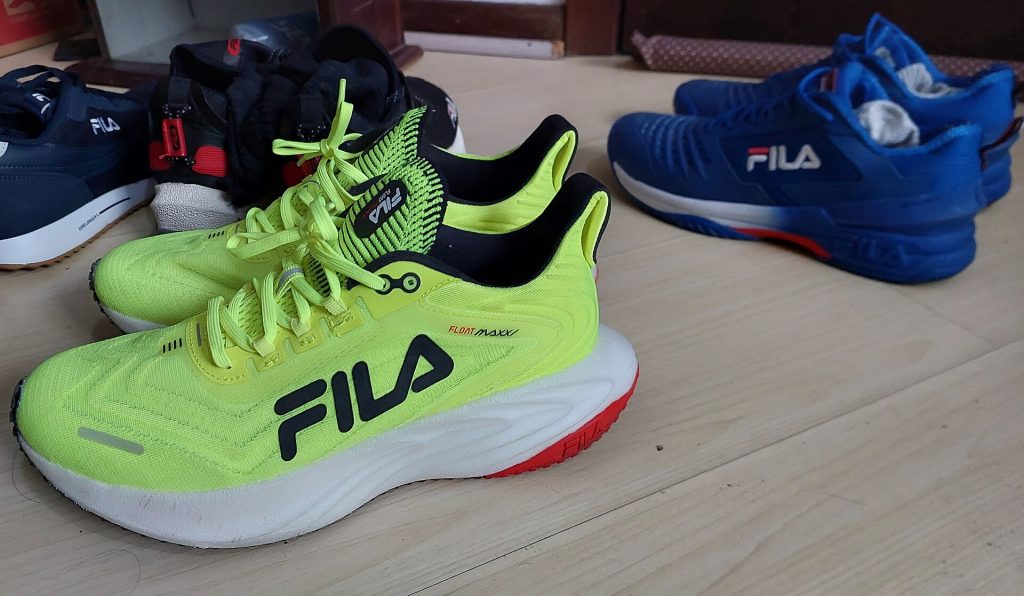
Mesh sags at the toe crease when the heat pressed overlay separates from the open mesh beneath it. The mesh itself rarely fails; the bond does.
An engineered upper is a sandwich of mesh face, hot melt film and backing. The film softens at body temperature, and at the flex point it takes the entire load in shear.
Sagging shows up as a soft pouch above the toes. Once the film has crept, the panel cannot be brought back, so the useful decision happens before the first walk.
A jacquard runner with a reinforced toe
Jacquard weaves the reinforcement into the mesh instead of bonding it on, so there is no film to delaminate at the crease. The trade is weight, because the weave is denser.
Look inside the toe box. A woven reinforcement shows as thicker yarn in the pattern; a bonded one shows as a smooth, slightly shiny patch with a visible edge.
Press the toe box flat with two fingers and release. A woven panel springs back evenly, while a bonded panel recovers in the middle and stays soft around its border.
Weight is the honest signal. A woven toe panel adds grams and removes the film, and the film is the part that fails first on a warm day.
A double layer engineered trainer
Two mesh layers with a film between them hold shape better than a single layer, because the film is protected from abrasion. It can still creep under repeated flexing.
Failure starts at the edge of the film, where the bond line ends. That edge is usually placed just behind the toe crease, which is the worst position available.
Find the edge by feel. Run a thumb backwards from the toe until the panel stops flexing freely; if that transition sits under the crease, expect a pouch within a few months.
The backing decides how it ends. A nonwoven backing tears along the bond line, while a knit backing stretches first and lets the film sit proud of the mesh.
Feel the panel an hour into a walk, not in the shop. Warm film softens, and a bond that is already creeping only feels loose once the foot has heated it through.
A mono mesh trail shoe with an external cage
A thin mono mesh with a separate cage puts the structural load on the cage and leaves the mesh to breathe. The crease forms in the mesh, but the panel cannot balloon.
The cage only helps if its anchors are stitched rather than glued. A glued cage pulls a patch of mesh with it when it lifts, and the patch never lies flat again.
Check the anchors at the eyestay. Stitching that passes through the cage means the load path is mechanical, and that is the one you want on a wet trail.
A cage also spreads lacing tension across the midfoot, which stops the mesh stretching where the eyestay pulls hardest on every step.
A mesh walking shoe with a stitched toe cap
A stitched toe cap moves the flex point back into leather, which is the one material that tolerates it. The mesh behind the cap barely creases at all.
It fails when the cap is too short. If the seam sits forward of the ball of the foot, the mesh still takes the fold and sags behind the stitching line.
Stand in the shoe and roll forward onto the ball. The seam should sit at or behind the widest part of the foot, never in front of it.
The cap has to be a real material with a cut edge, not a printed shape. A printed cap is decoration, and it moves the flex point nowhere at all.
Count the rows of stitching. One row spreads the load across the seam, while two rows set close together stiffen the cap and push the crease back into the mesh.
A coarse open mesh sneaker with an internal rand
A coarse mesh has large openings and long yarn floats, which spread a crease across a wide area instead of concentrating it. An internal rand stops the toe collapsing.
Open mesh is abrasive against itself. Without a lining the yarns fray where the crease repeats, and a hole opens before the panel has time to sag.
Turn the shoe inside out as far as it will go and look behind the toe. Bare mesh on the inside is a short life, whatever the outer surface promises.
Look under the toe as well. A rand stitched to the upper and not only bonded keeps its shape when the crease repeats, which is most of what matters.
Rand thickness counts for less than where it ends. It should stop short of the crease, or it will hold the toe rigid and fold the mesh just behind it.
Mesh failures are quiet. There is no crack and no split, just a panel that gradually stops holding the foot, which is why the checks happen before the first walk.