Four shoe trees and what each one does to the crease pattern

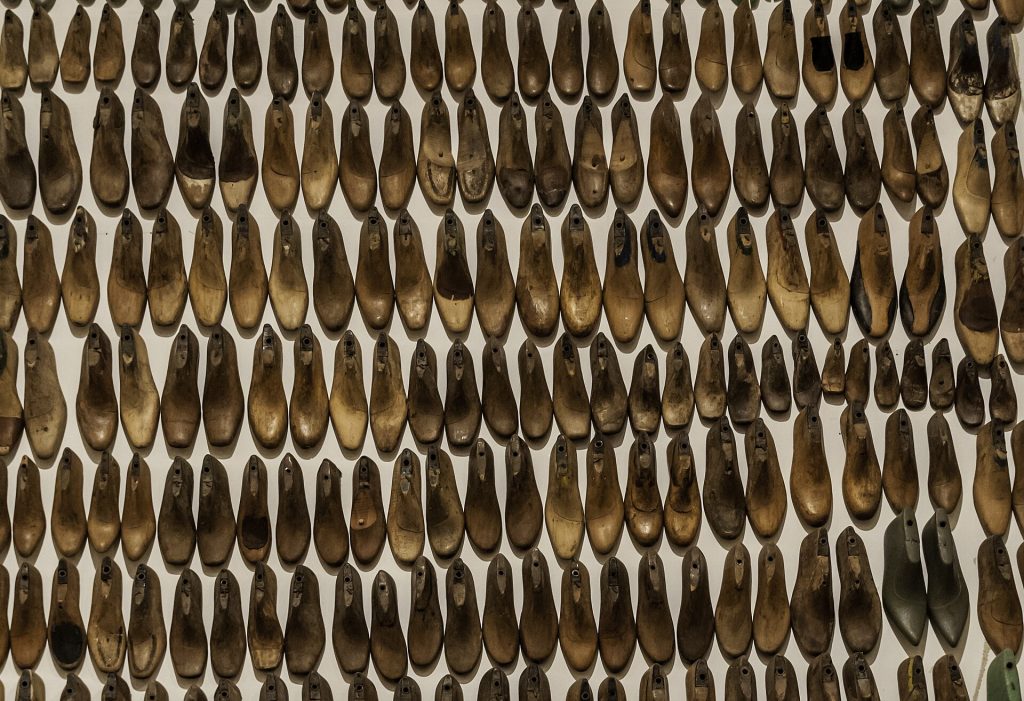
A shoe tree does not remove creases. It decides where the next one forms, because it holds the upper under tension in one direction and leaves the rest of the vamp free to fold.
That is why two trees of the same size can give two different crease patterns on the same pair of shoes. The tension direction matters more than the wood.
These are the four shapes I keep, and the pairs I would and would not put them in.
A full cedar tree fills the toe and loads the vamp
This is the default for a leather shoe with a structured toe. The front block reaches the end of the box, the heel piece presses the counter, and the vamp sits slightly stretched across its whole width. Tension across that width is the point.
A crease forms where the upper has slack when the foot flexes, so a panel held flat folds in fewer, deeper lines rather than a washboard of shallow ones. Size the tree by the heel, not the toe: the heel piece should sit snug while the front block just touches, and a tree needing two hands to push home is a size too big.
Cedar also takes moisture out through the toe overnight. Raw cedar, not varnished, and not so large that you have to force it in, because a tree that stretches the shoe sideways widens the fit permanently.
On a soft unlined toe, a full tree can push the box out of shape from the inside. That pair wants the split shape below instead.
A split toe tree adds width and forgives a tight fit
The split front is two halves on a spring. It presses outward against the sides of the forefoot, which is useful on a shoe that has softened and spread, or on one that fits slightly narrow.
What it does to the crease is different: the pressure is lateral, so the vamp is held wide but not pulled lengthwise. On a soft calf derby that produces a broader, shallower fold across the ball instead of a sharp diagonal.
Do not leave a split tree in a shoe that is already loose. It keeps widening the forefoot, and after a season the shoe will feel a half size bigger with nothing to blame but the tree.
The spring is the part that wears out. When the halves stop pushing back on their own, the tree is doing nothing except taking up space, and it rattles around inside the shoe every time the shelf gets knocked.
A heel-only or spring tree shapes the back and nothing else
These hold the heel counter upright and keep the topline from curling, which is worth having. They do nothing for the vamp, and the vamp is where creasing happens.
On a stiff boot with a structured toe, that is fine. The toe box holds itself and the counter is the part that collapses. On a soft unlined loafer, a heel-only tree leaves the whole forefoot unsupported and the crease sets deep within a month.
A spring tree also puts pressure on the counter from inside. If the counter is already soft, that pressure slowly pushes it outward and the heel starts to slip.
Weight matters as much as shape. A light hollow tree cannot hold a heavy boot upright, and a heavy one left in a soft loafer pulls the topline down over a long summer. Most shoes also come out of the box with one of these in the toe, which is packaging rather than care, and it is why a lot of people assume the job is done.
A shaped last or insert is for the pair you cannot replace
A last cut to the shoe’s own shape holds the entire upper, toe to heel, in the position it was built in. Nothing is left unsupported, so the crease pattern barely changes over years.
It is slow and expensive, which is why it belongs on a goodyear welted pair you intend to resole twice. For a pair you will replace in two years, a full cedar tree gets most of the benefit at a fraction of the effort.
Never store leather in a plastic tree. It holds moisture against the lining, and a damp interior is how a shoe grows a crease that will not come out and a smell that will not either.
Buy them in pairs. One last in one shoe leaves the other to crease on its own schedule, and after a year the two no longer match in profile. Whatever shape you choose, put it in while the shoe is still warm from the foot, because the upper is most willing to be held flat in the first few minutes after you take it off.