Six kitchen shoes that survive grease, water and a hot floor

A kitchen floor is not wet, it is coated. Water you can walk on; a film of oil and water on quarry tile will put you down in one step.
The job is pivot, carry, side step, reach into a low fridge, then stand still at the pass with a hot pan in both hands. The shoe has to do all of that without a lug that packs solid by the second service.
I worked a month of service in each pair, on tile, on a rubber mat and on the concrete of a dry store. These six still had tread at the end of it.
A lug pattern with open channels that sheds instead of packing
Fine siping and tight blocks hold grease the way a brush holds paint. Once the gaps are full the outsole is a smooth slab with a pattern printed on it.
Look for wide, straight channels running heel to toe, at least four millimetres across, with blocks that taper towards the edge. Oil and water need a route out from under the foot.
Stand on a wet tile and twist. If the shoe grabs and then releases with a squeak, the channels are working. If it slides smoothly, they are not.
A sole that stays hard at sixty degrees
Cheap rubber softens near the pass and the tread folds over itself. A shoe that grips at room temperature can be useless two metres from a range.
Nitrile blends hold their hardness better than plain rubber and resist swelling in oil. Ask what the outsole is made of rather than trusting the word non slip on the box.
Leave a test pair near the dish machine for a week. If the sole has gone tacky and picked up a grey film, it will do the same in your kitchen by Friday.
The same heat softens the cement at the toe. A sole that lifts at the front in August is a sole that was never meant for a working kitchen.
A moulded upper with no seam at the flex point
Canvas and stitched leather both fail at the crease across the toes, because that is where water enters and salt collects.
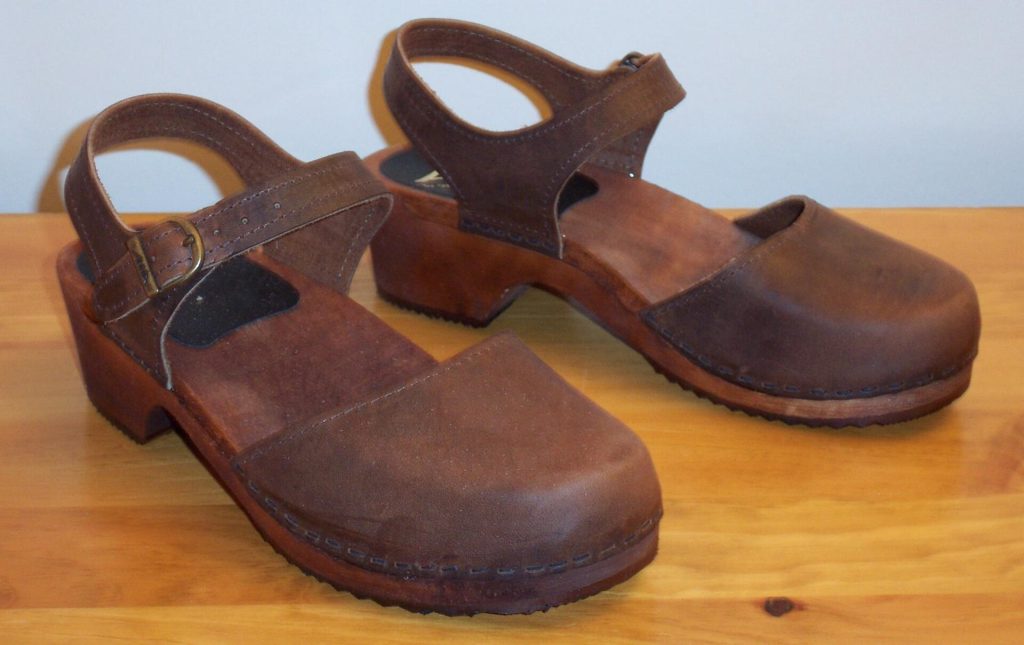
An injected clog or a one piece moulded upper has no seam to rot. If you want leather, make sure the vamp is a single panel and the stitching sits behind the flex line.
Look inside after a month. A dark tide mark above the welt means water is wicking through the seam, not merely sitting on the surface.
A heel you can step out of at the bin
Kitchens run on small trips, and a shoe with a soft, collapsing heel counter lets you slide in and out without untying. It still holds on the move if the midfoot is snug.
That is a real specification, not laziness. Check that the counter is padded and cut low at the back, around 55 mm, so the heel clears it without crushing the leather.
The trade off is security on a wet floor. If the shoe comes off when you pivot, it is too loose for service and belongs in the pot wash.
A wide base under the ball for pivot work
Every turn at the pass is a pivot on the ball of one foot. A narrow, curved outsole edge rolls the ankle outward under a loaded turn.
Put the shoe on a flat surface and look from the front. The widest point of the outsole should sit under the metatarsal heads, not behind them.
Narrow waists look elegant and are the first thing to twist out of shape. A kitchen shoe should look slightly clumsy from above, and it should.
A footbed that comes out and goes in the wash
Kitchen shoes take on water from above and sweat from below, and a fixed footbed never dries. That is where the smell comes from and where the foam dies.
A removable, closed cell footbed can be washed at the end of a shift and dried on a rack. Check that it has a heel cup, or it will slide forward inside a wet shoe.
Replace it at the first flat spot. The upper will outlast two footbeds if the seams are sound, and a new liner is cheaper than a new pair.
Grease resistance is a material property, not a feature in a brochure. Ask what the sole is made of, and test it wet before you trust it with a service.
The pair that lasts a year in a kitchen is the pair that still has tread in February, and it rarely looks like the pair you wanted.